SQUATS STILL THE KING
If you could only choose one strength exercise, the barbell back squat would be near the top of the list. It builds lower-body strength, develops muscle, burns calories, improves athletic performance, and even challenges your core. Learn proper squat technique and you'll get more results from one exercise than almost any other movement in the gym.
Squat Technique
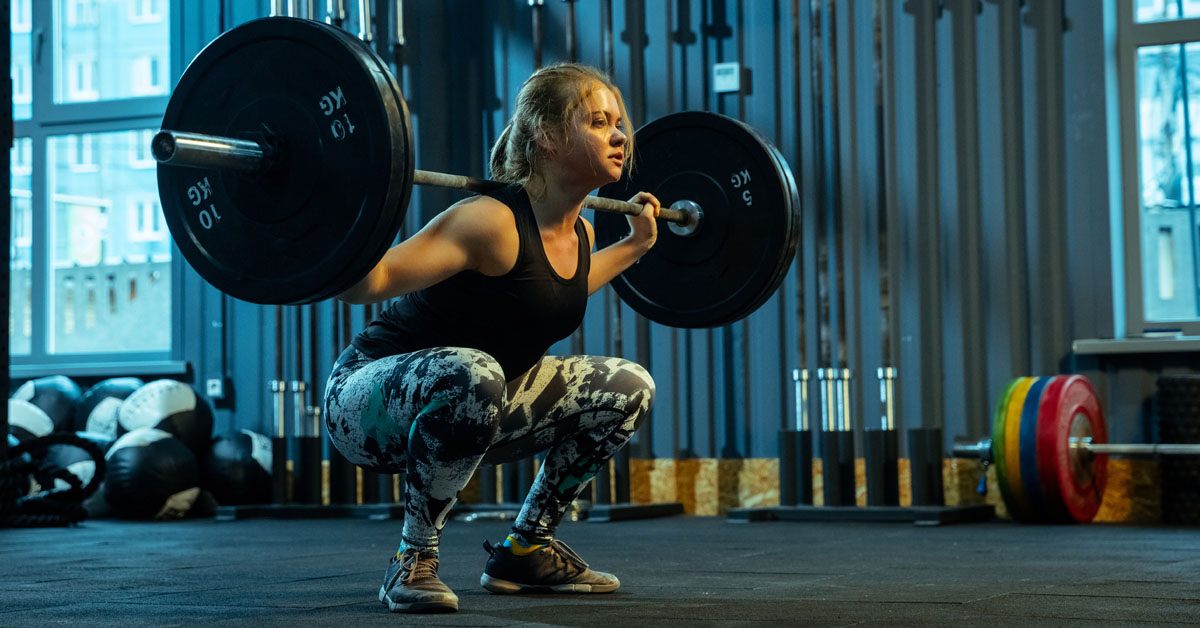
Many experts believe that the barbell squat is still the best exercise you can do at the gym! But it all starts with proper technique. This monster movement can cause injuries if not performed correctly. You should always perform squats with a neutral spine. Never round your back. Think "butt out, chest out." This simple cue helps maintain a neutral spine throughout the movement and reduces unnecessary stress on your lower back. In the image below, you can see how the athlete has kept a neutral spine throughout the movement.

Stance Width
You should always start with whatever is most comfortable for you. For most people, that's going to place your feet shoulder width apart with your toes slightly flared out.
Regardless of the width of your stance, your knees should track in the same direction as your toes. In other words, if you have a narrow stance, then your toes should point forward. If you start with a wider stance, then your toes should flare out. Improper form can put an extraordinary amount of stress on your knee ligaments.
Squats for Power
Barbell squats are great for building muscle and burning fat, but sometimes you may have sport specific goals to increase power. In that case, Sogabe et al. (2010) concluded that a stance of about 150% of shoulder width produces more power than a narrow stance. But don't go too wide. A stance of 200% shoulder width did not produce as much power as 150%. Therefore, start with a shoulder-width stance. If your goal later becomes maximizing power for sports, experiment with widening your stance to approximately 150% of shoulder width.
Squat Depth
How low should you go? You should always squat to a comfortable depth. The most important thing is safety. But if you can go low, then the lower the better. A deep squat is what is recommended for the most gluteus maximus activation. Caterisano et al. (2002) tested three different squat depths for activation of the gluteus maximus among other muscles. The data suggest that the lower you go, the more the gluteus maximus will contribute to the total concentric forces of the movement. Squat only as deep as you can while maintaining proper technique. As your mobility improves, your squat depth will often improve naturally. But remember, good technique should always take priority over squat depth.
If your tight muscles are keeping you from getting lower, you can always improve flexibility by adding more stretches to your routine. Therefore, don't forget to stretch your glutes, quads, hams, and calves to improve your squat depth.

Quadriceps
Squats vs. Leg Extensions? I see many gym members run for the leg extension machine thinking it's the best exercise for the quads. But, is the leg extension machine better than barbell squats? Signorile et al. (1994) compared the EMG activity of the quadriceps muscle while the subjects performed barbell squats and knee extensions. The data showed that there was more electrical activity in the quadriceps muscle during the barbell squat exercise, than the leg extension exercise.
Leg extensions are an excellent accessory exercise, but if you only have time for one quad exercise, the evidence suggests choosing the barbell squat.
But, if you want to emphasize quads during squats, you may want to give front squats a try. Yavuz et al. (2015) showed that your quads were more active in the front squat, than the back squat.

Core Muscles
Surprisingly, heavy back squats challenge your core just as much as many traditional abdominal exercises. The barbell back squat may not only be the king of leg exercises—it may also be one of the best exercises for developing a strong core. If you think planks are great ab exercises, then you're really not going to believe this! Van den Tillaar (2018) compared core activation between a plank to failure versus a 6RM barbell back squat. It turns out that the rectus abdominis and obliques were equally activated in both exercises; but, the erector spinae muscle was more active in the barbell back squat. Therefore, athletes may be better off spending more time squatting and less time planking, to increase strength and power in their legs AND their core.
A strong core and six pack abs are two different topics. But, if your goal is six pack abs, then we have some tips and tricks to help you get there.

Burning Fat
As we all know, the best movements for burning calories and losing weight are total body movements. If your goal is to lose weight, then you need to include as many total body movements as possible. The barbell squat recruits muscles throughout your body, burns more calories than most isolation exercises, builds lean muscle, and helps increase your daily energy expenditure over time. Few exercises provide as much return for your effort as the barbell back squat.
Squats will not be as good as running for total caloric expenditure, but if you can include squats in your routine, you will get the benefits of strength training and cardio exercise in one punch!

Sources:
Caterisano, Anthony, et al. “The Effect of Back Squat Depth on the EMG Activity of 4 Superficial Hip and Thigh Muscles.” Journal Of Strength And Conditioning Research, vol. 16, no. 3, Aug. 2002, pp. 428–432.
Signorile Joseph F.; Weber, Brad; Roll, Brad; Caruso, John F.; Lowensteyn, Ilka; Perry, Arlette C. “An Electromyographical Comparison of the Squat and Knee Extension Exercises.” Journal of Strength and Conditioning Research: vol. 8, no. 3, Aug. 1994, pp. 178-183.
Sogabe, Akitoshi, et al. “Influence Of Stance Width On Power Production During The Barbell Squat.” Journal of Strength and Conditioning Research (Lippincott Williams and Wilkins), vol. 24, Jan. 2010, p. 1.
van den Tillaar, Roland, and Atle Hole Saeterbakken. “Comparison of Core Muscle Activation between a Prone Bridge and 6-RM Back Squats.” Journal Of Human Kinetics, vol. 62, June 2018, pp. 43–53.
Yavuz, Hasan Ulas et al. “Kinematic and EMG Activities during Front and Back Squat Variations in Maximum Loads.” Journal of sports sciences 33.10 (2015): 1058–1066. Web.